
How long professional house cleaning should take
Quick answer
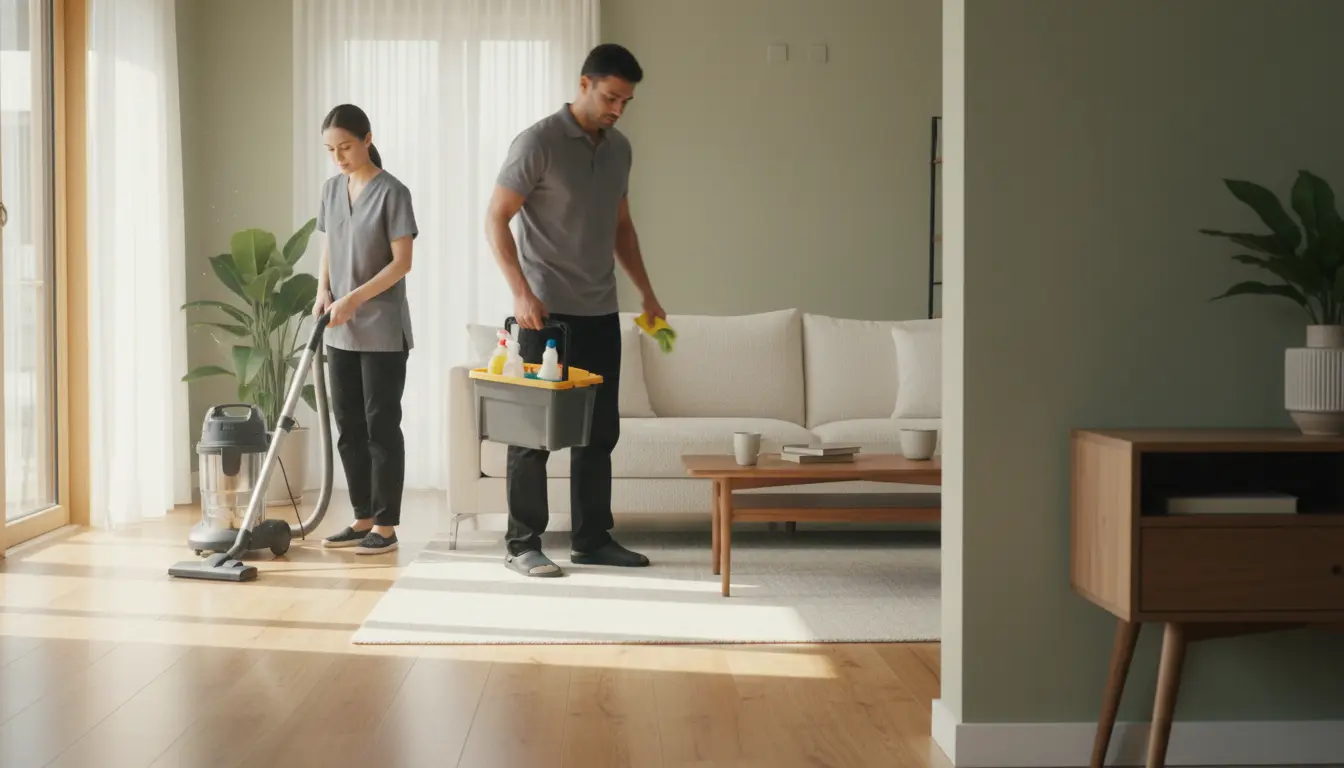
For a standard professional house cleaning, expect about 1.5-3 labor-hours for a small apartment, 3-5 labor-hours for an average 3-bed/2-bath home, and 4-7 labor-hours for larger 4-5 bedroom homes. "Labor-hours" means total hours of work by all cleaners combined. So a 4-hour job with two cleaners on-site is 8 labor-hours, but only 4 clock hours in your home.
First-time or "catch-up" cleanings are almost always at the high end (or above) these ranges, while regular weekly or biweekly cleanings land near the low end. Deep cleaning, move-out, or post-construction jobs will take longer than the standard house cleaning covered here.
Typical cleaning times by home size
These estimates are for standard professional house cleaning: dusting, wiping reachable surfaces, cleaning bathrooms, cleaning the kitchen surfaces (not inside appliances), taking out trash, and vacuuming/mopping floors. They assume a generally tidy home without major buildup.
Times below are in labor-hours, not clock hours in your home.
| Home size (approx.) | First or "catch-up" standard clean | Recurring weekly/biweekly clean |
|---|---|---|
| Studio or 1 bed / 1 bath (≤800 sq ft) | 2-4 labor-hours | 1.5-2.5 labor-hours |
| 2 bed / 1-2 bath (800-1,200 sq ft) | 3-5 labor-hours | 2-3.5 labor-hours |
| 3 bed / 2 bath (1,200-1,800 sq ft) | 4-6 labor-hours | 3-5 labor-hours |
| 4-5 bed / 2.5-3+ bath (1,800-2,500+ sq ft) | 5-8+ labor-hours | 4-7 labor-hours |
To translate that into time in your home, divide by the number of cleaners. For example:
- A 3 bed / 2 bath first clean at ~5 labor-hours
- With 1 cleaner: ~5 hours in your home
- With 2 cleaners: ~2.5 hours in your home
If your home hasn't been professionally cleaned in a long time, or you want extras like inside the fridge or oven, expect to be at the high end of these ranges or beyond.
What makes a cleaning faster or slower
Plenty of factors can push you above or below the typical time for your home size.
Things that add time
- Lots of clutter: Picking up toys, clothes, and piles of paper slows cleaners down because they can't reach surfaces and floors quickly.
- Heavy buildup: Soap scum, hard water stains, greasy stove tops, and dirty baseboards all take scrubbing time instead of a quick wipe.
- More bathrooms: Bathrooms are the most time-intensive rooms. A 2-bath home can take noticeably longer than a similar-size 1-bath home.
- Pets: Pet hair, paw prints, nose marks on glass, and litter tracking add to vacuuming and mopping time.
- Special requests: Inside appliances, hand-wiped blinds, detailed baseboard work, or interior windows are often add-ons and extend the visit.
- Long gaps between visits: Going months between professional cleanings usually means more dust and buildup everywhere.
Things that save time
- A reasonably tidy home: When counters, floors, and surfaces are mostly clear, cleaners can move quickly and focus on actual cleaning.
- Regular schedule: Weekly or biweekly cleaning prevents buildup, so each visit is more about maintaining than rescuing.
- Efficient layout and materials: Open floor plans, hard floors instead of lots of carpet, and easy-to-clean surfaces all help.
- Experienced team: Pros who know their routine and your home layout move faster while still doing a thorough job.
The bottom line: a well-maintained, relatively tidy home on a regular schedule will usually be cleaned near the low end of the time ranges; everything else nudges you toward the high end.
How to estimate the right time to book
Most cleaning services will help you estimate, but it's useful to come in with your own rough idea.
1. Start with your home size
Use the table above to pick a baseline labor-hour range based on bedrooms, bathrooms, and square footage.
- If this is your first professional visit in a while, start with the first/catch-up range.
- If you already have a cleaner and are just switching companies, the recurring range is more realistic.
2. Adjust for your situation
Add time if you:
- Have more bathrooms than typical for your home size (+0.5-1 labor-hour for each extra bathroom)
- Know there is heavy buildup in the kitchen or primary bathroom (+0.5-1.5 labor-hours)
- Have multiple shedding pets (+0.5-1 labor-hour)
- Want several special add-ons (inside oven, fridge, detailed baseboards, etc.) (+0.5-2 labor-hours, depending on the list)
3. Convert labor-hours into time in your home
Once you have an estimate in labor-hours, divide by the number of cleaners. For example:
- You estimate 4.5 labor-hours
- 1 cleaner → about 4.5 hours in your home
- 2 cleaners → about 2.25 hours in your home
- 3 cleaners → about 1.5 hours in your home
Most companies will round up a bit to allow for setup, packing up, and minor surprises.
4. When in doubt, round up (especially for the first visit)
For a first-time cleaning, it's usually safer to book a little more time than you think you need. That way the cleaners aren't rushed, and you can see what they accomplish in that window. On later visits, you can tighten or adjust the time based on results.
Good questions to ask the cleaning company:
- Is the quoted time per cleaner or total time on-site?
- What exactly is included in a standard vs deep cleaning?
- What happens if the team finishes early?
- What happens if they run out of time before the list is done?
Clear answers to these help you match your expectations to the time you're paying for.
Signs your cleaners are using the time well
Since you're investing in those hours, it's fair to pay attention to how they're used.
Healthy signs:
- Systematic approach: They work room by room instead of jumping around randomly.
- Visible progress: By the end of the visit, bathrooms, kitchen surfaces, and main living areas look freshly cleaned, not just lightly straightened.
- Right tools on hand: They bring what they need and don't spend lots of time hunting for supplies around your house.
- Focused work: Short breaks are normal, but most of the visit is steady cleaning, not phone time or long chats.
- Improvement over time: After the first visit, recurring cleanings should be more consistent and sometimes a bit quicker as they learn your home.
If you feel like the results don't match the time spent, bring it up with the company. Most will happily clarify what was done or adjust time or scope on future visits.
Final thoughts
For professional house cleaning, most homes fall in the 1.5-7 labor-hour range depending on size, condition, and frequency; if you start from those benchmarks and adjust for your situation, you'll be very close to the right amount of time to book.